
Design guide
Clear. Open.
Held in common.
A shared visual language with Humans Are In Charge, and an identity of our own.
01 / The mark
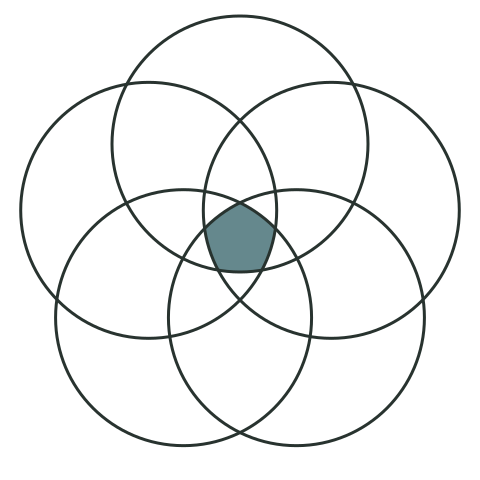
Five circles.
One shared center.
Five equal circles meet around a common center. The charcoal outlines preserve each circle; blue-green appears only in the region shared by all five.
Keep the circles equal, the arrangement balanced, and the background open. Do not fill the circles, color the partial overlaps, or stretch the geometry.
The five circles do not assign five roles or represent a fixed membership. They express distinct perspectives finding common ground.
Use the fine-line mark at large sizes. The header and favicon use a heavier line to preserve the form at smaller sizes.
02 / Color
Quiet color.
Clear purpose.
Warm white
#FAFAF7
Page background
Charcoal
#28332F
Text and circle outlines
Muted blue-green
#65888D
Shared center and illustration
Deep blue-green
#436F76
Links and actions
03 / Type and composition
Good judgment begins
with a clear understanding.
Give ideas
room to breathe.
Use Avenir Next, with Segoe UI and Arial as fallbacks. Set headings in sentence case, keep reading lines comfortable, and use generous space to make the structure clear.
Keep the mark and wordmark together in the header and footer. Repeat the same navigation in both places, and give the first viewport particular care.
Use motion sparingly to guide attention. Respect reduced-motion preferences and keep every page useful without animation.
04 / Illustration and language
Human, simple,
and grounded.
Use simple lines, restrained detail, and muted blue-green. Show people engaged in shared work. Leave room for readers to see themselves in the scene.
Write clearly, without condescension or inflated claims. Distinguish responsibility—the continuing duty to perceive, judge, and act—from accountability: answering for outcomes and carrying their consequences.
The visual family draws on HAIC’s working guide. Public reuse and endorsement terms remain to be defined.
Read the HAIC design guide